
When to Fight to Keep People (And When to Let Them Go)
Most companies fight to keep everyone. The best fight to keep the right people.
There’s a moment every manager dreads. Your best engineer walks into your office and says she’s got an offer from a competitor. Or your top sales rep mentions he’s “exploring options.” Or your operations lead - the one who knows every process, every customer quirk, every workaround that keeps things running - casually drops that a recruiter has been calling.
Your immediate reaction is probably some version of panic. You start calculating: How long would it take to replace them? What would it cost to recruit someone new? How much institutional knowledge would walk out the door? What would happen to the team’s morale? And within about thirty seconds, you’ve convinced yourself that you need to do whatever it takes to keep this person. You start thinking about counteroffers. Salary bumps. Title changes. Special accommodations. Whatever they want, you’ll figure it out.
Here’s the uncomfortable truth: this panic-driven approach to retention is often exactly wrong.
Not because you shouldn’t fight to keep great people - you absolutely should. But because the decision about when to fight and when to let someone go shouldn’t be made in a moment of panic with incomplete information and no framework for thinking through the tradeoffs. Most managers operate on pure instinct when it comes to retention decisions: keep the people you like, accept that others will leave, react to offers when they materialize, hope for the best. There’s no systematic thinking about which retention battles are worth fighting, which exits actually help your organization, or what the real economics look like.
The result? Companies overpay to retain mediocre performers who have leverage, while simultaneously losing exceptional people they could have kept with relatively modest investments. They negotiate desperate counteroffers with employees who have already mentally checked out, burning goodwill and budget on retention attempts that fail six months later anyway. They treat all turnover as equally bad, failing to distinguish between regrettable losses and addition-by-subtraction exits.
Here’s what great operators understand: retention is not a binary choice between keeping everyone or accepting high turnover. It’s an optimization problem. The goal isn’t minimizing turnover. The goal is maximizing the return on your retention investments - being strategic about which people you fight to keep, which exits you facilitate gracefully, and which situations require difficult conversations about fit.
This is Retention Economics: a framework for thinking systematically about when retention investments pay off and when letting people go is actually the right move for both the organization and the individual.
Understanding the Retention ROI Model
Let’s start by making explicit what most managers calculate intuitively but imprecisely. Every retention decision is fundamentally an economic tradeoff between two scenarios:
Scenario A: Keep the person (with whatever it takes to retain them)
Scenario B: Let them go (and deal with replacement)
The question is: which scenario creates more value after accounting for all costs?
The Basic Retention ROI Formula
Retention ROI = (Future Value of Employee) - (Cost to Retain)
Compare to:
Replacement ROI = (Future Value of Replacement) - (Total Replacement Cost + Transition Cost)
Decision Rule:
If Retention ROI > Replacement ROI → Fight to keep them
If Replacement ROI > Retention ROI → Let them go (gracefully)
Simple in principle. Complex in practice because each variable requires judgment and estimation. Let’s unpack what goes into each component.
Future Value of Employee (If You Keep Them)
This isn’t just “how good are they now?” It’s a forward-looking assessment of what value they’ll create over the next 2-3 years if they stay. Consider:
Current Productivity Level:
Are they in the top 20% of performers? Middle 60%? Bottom 20%?
How does their output compare to team average?
What’s their quality level (defects, rework, customer satisfaction)?
Growth Trajectory:
Are they improving, plateauing, or declining?
How much upside is left in their development?
Are they learning new skills or coasting on what they know?
Institutional Knowledge Value:
Do they hold critical information that’s hard to transfer?
Are they the only person who knows certain systems/relationships?
How proprietary is their knowledge vs. industry-standard skills?
Cultural Impact:
Do they raise or lower the performance bar for others?
Are they mentoring/developing other team members?
Do they amplify or drain team energy?
Team Dynamics:
How dependent are others on them?
Would losing them create a cascade of other exits?
Or would their exit actually improve team function?
The future value calculation gets tricky because you’re trying to predict not just what they’ll produce, but also what they’ll cost in terms of management time, coordination overhead, and cultural impact. A high-output person who creates political drama might have negative net value despite strong individual metrics.
Cost to Retain
What will it actually take to keep this person, and what are you giving up by spending those resources here instead of elsewhere?
Direct Compensation Adjustments:
Salary increase needed to match or beat outside offer
Bonus or equity grants to create golden handcuffs
Premium over market rate to make them feel valued
Indirect Costs and Accommodations:
Title promotion (creates salary compression issues with others)
Remote work flexibility (if it’s an exception to team policy)
Special project assignments (opportunity cost of not giving those to others)
Reduced workload or responsibilities (someone else absorbs them)
Opportunity Cost:
That $20K raise could have gone to three high-performers as merit increases
That VP title creates expectations from others who’ve been here longer
That remote exception becomes a precedent you’ll have to defend
Future Retention Costs:
If you cave to pressure now, you’ve signaled that threatening to leave works
Next negotiation will start from this new baseline
Other team members may use this playbook
The cost isn’t just the immediate financial hit. It’s the precedent you’re setting, the expectations you’re creating, and the resources you’re deploying here instead of investing in other team members who haven’t threatened to leave.
Total Replacement Cost
If you let them go, what does it actually cost to get back to equivalent productivity with someone new?
Direct Recruiting Costs:
Agency fees (typically 20-30% of first-year salary)
Internal recruiter time
Job board postings, marketing
Interview time from hiring manager and team
Onboarding and Training Costs:
HR onboarding administrative time
Manager time getting them up to speed
Team member time doing knowledge transfer
Training programs, certifications, tools
Productivity Ramp Time:
Junior roles: 3-6 months to full productivity
Mid-level roles: 6-9 months
Senior/specialized roles: 9-18 months
During ramp, they’re producing <100% while consuming >100% of management time
Productivity Gap During Search:
Time from resignation notice to new hire start date
Remaining team members absorb the work (overtime, delayed projects)
Opportunities missed because capacity wasn’t available
Risk Costs:
What if the replacement doesn’t work out? (30-40% of hires don’t make it past year one)
What if the search takes 3 months longer than expected?
What if market rates have risen and you’re priced out of good candidates?
The Math by Role Level:
Junior roles (individual contributors, <2 years experience):
Replacement cost: 50-75% of annual salary
Ramp time: 3-6 months
Mid-level roles (experienced ICs, first-time managers):
Replacement cost: 100-150% of annual salary
Ramp time: 6-9 months
• Senior roles (senior ICs, experienced managers, specialized experts):
Replacement cost: 200-400% of annual salary
Ramp time: 9-18 months
These aren’t small numbers. A $100K mid-level employee who leaves costs you $100K-150K to replace. A $150K senior person costs $300K-600K when you add up all the components. This is why the instinct to “do whatever it takes to keep them” often makes sense - replacement is genuinely expensive.
But here’s the critical question: what’s the future value of the replacement compared to the person who’s leaving?
Future Value of Replacement
This is where most retention calculations go wrong. Managers compare the cost of retention to the cost of replacement, but forget to factor in that the replacement might actually be better.
If the person threatening to leave is a B-player, and you can recruit an A-player as their replacement, the math changes dramatically. The replacement cost is high, yes, but the future value delta is enormous.
Consider:
Upgrading performance: Moving from 50th percentile to 75th percentile performance means 30-50% more output from that seat
Resetting compensation: New hire starts at market rate, not inflated retention rate
Cultural refresh: New person brings outside perspective, challenges assumptions, introduces new approaches
Team dynamics reset: Opportunity to eliminate dysfunction that had calcified around the existing person
The counterintuitive insight: sometimes the best retention strategy is letting people go and upgrading the replacement.
Transition and Exit Costs
But there’s one more variable: what does the actual transition cost you?
Direct Exit Costs:
Severance (if you’re initiating the exit)
Accrued PTO payout
COBRA/benefits continuation
Exit interview time
Knowledge Transfer Costs:
Documentation of processes/relationships
Handoff meetings with team
Manager time overseeing transition
Risk of information loss despite best efforts
Team Morale Impact:
Do remaining team members see this as losing a valued colleague?
Or as removing someone who was dragging things down?
Does this create retention risk with others?
Or does it send a positive signal about performance standards?
Customer/Stakeholder Impact:
Are there relationships that might be disrupted?
Will customers/partners need reassurance?
Is there contract/project continuity risk?
The transition costs vary wildly depending on role, performance level, and how you handle the exit. A graceful, well-managed exit of a wrong-fit employee can actually improve team morale and send positive cultural signals. A botched exit of a valued performer can trigger a cascade of other departures.
The Retention Decision Matrix
Now that we understand the variables, let’s build a systematic framework for making retention decisions. The two key factors that determine your strategy:
X-axis: Employee Performance (Low → High)
How valuable is this person’s current and future contribution?
Y-axis: Replacement Difficulty (Easy → Hard)
How hard would it be to find an equally good or better replacement?
This creates four quadrants, each requiring a different retention approach.
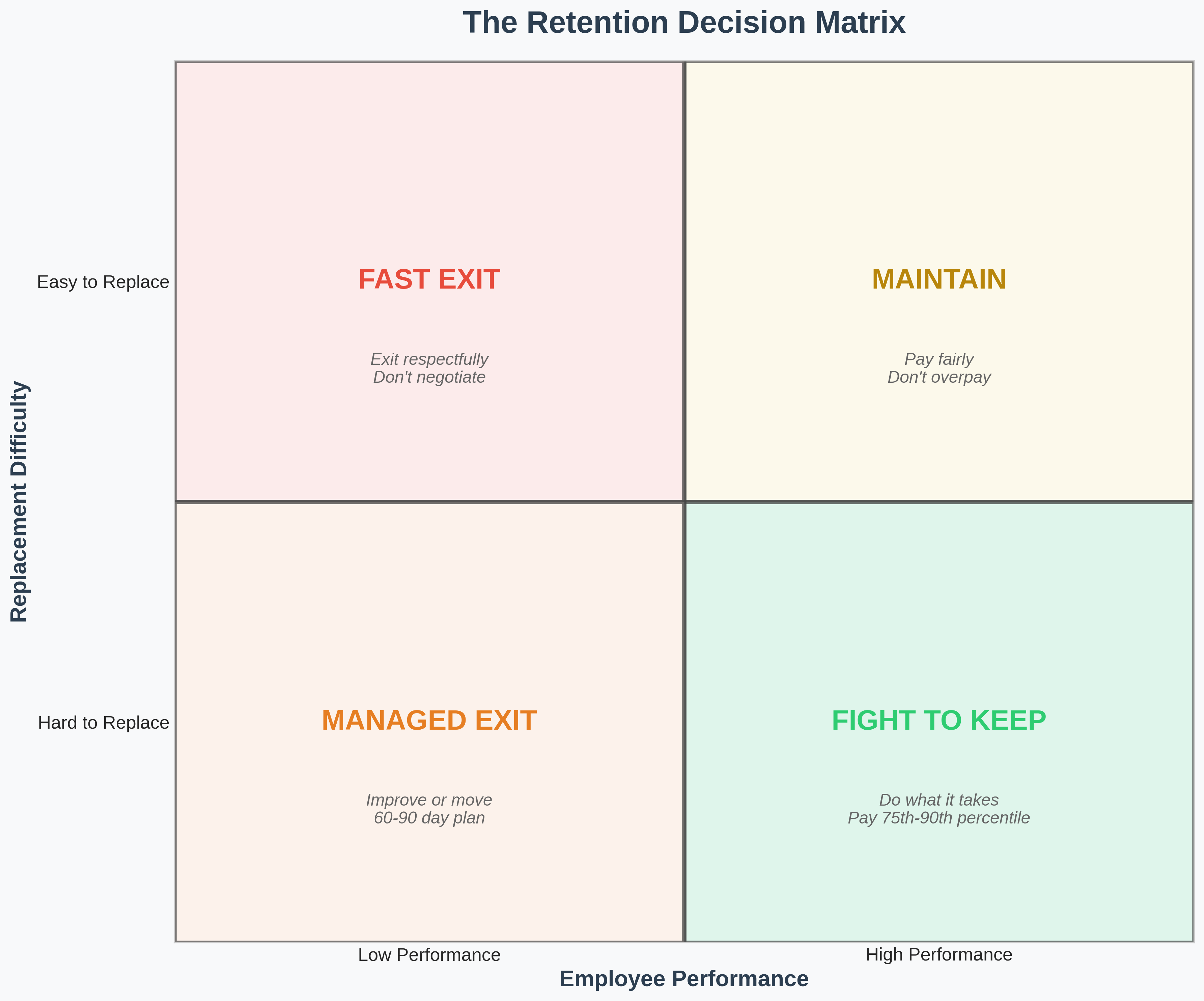
Quadrant 1: High Performance + Easy Replacement
Strategy: MAINTAIN (Don’t overpay)
These are good performers in roles where the talent market is deep. Think: solid mid-level engineers in major tech hubs, competent sales reps in established territories, capable operations managers in common industries.
What to do:
Pay at 50th-75th percentile of market
Provide good (not exceptional) development opportunities
Appreciate their contribution but don’t create golden handcuffs
If they get a better offer, match within reason but don’t go crazy
What NOT to do:
Don’t overpay to retain at all costs
Don’t promote them just because they threatened to leave
Don’t create special accommodations that become precedents
Why this works:
If they leave, you can replace them relatively easily with someone of similar quality. Fighting too hard to keep them often means overpaying for replaceable talent, which creates salary compression issues and sets bad precedents.
Quadrant 2: High Performance + Hard Replacement
Strategy: FIGHT TO KEEP (Do what it takes)
These are your exceptional performers in specialized roles or tight labor markets. Top 10% engineers with rare skills, rainmaker sales leaders with major client relationships, operations experts with deep institutional knowledge in complex environments.
What to do:
Pay at 75th-90th percentile (or higher for truly exceptional)
Create strong golden handcuffs (equity, retention bonuses)
Provide exceptional development and growth opportunities
Give them interesting projects and high autonomy
Match or beat any reasonable outside offer
Have proactive retention conversations quarterly
What NOT to do:
Don’t wait until they have an offer to invest in retention
Don’t assume loyalty means you can underpay
Don’t ignore signs of disengagement
Why this works:
The replacement cost is enormous (18+ months of productivity gap, 200-400% of salary in hard costs), the risk of not finding an equal replacement is high, and the future value delta is massive. Overpaying to keep them is often cheaper than the replacement scenario.
Quadrant 3: Low Performance + Easy Replacement
Strategy: FAST EXIT (Don’t negotiate)
These are underperformers in roles where replacements are readily available. Bottom 20% performers in common roles, wrong-fit hires, people who’ve plateaued well below where the role needs to be.
What to do:
Exit them respectfully but decisively
Generous severance (6-8 weeks per year of service)
Clear, honest feedback about fit
Help with job search if appropriate
Fast, clean execution
What NOT to do:
Don’t negotiate or create retention packages
Don’t delay hoping they’ll magically improve
Don’t create performance improvement plans that drag on for months
Why this works:
Keeping them is expensive (low productivity, high management time, negative team impact). Replacing them is relatively easy and often yields a significant upgrade. The ROI on retention is deeply negative.
Quadrant 4: Low Performance + Hard Replacement
Strategy: MANAGED EXIT (Coach Up/Coach Out - Improve or move)
These are underperformers in specialized roles where replacements are hard to find. Someone with rare skills who isn’t performing well, or someone in a niche role where the talent pool is thin.
What to do:
Give them one real chance to improve (60-90 days, clear metrics)
Provide coaching and resources
If no improvement, help them transition to a better-fit role (internal or external)
If they leave voluntarily, accept it and invest in the search
Consider restructuring the role or building internal pipeline
What NOT to do:
Don’t keep them indefinitely because “we can’t find anyone else”
Don’t lower standards just because replacement is hard
Don’t create a retention package for someone who’s not performing
Why this works:
You give them a real shot to improve (sometimes people in the wrong role can thrive with the right support). If they can’t improve, you transition them out despite the replacement difficulty, because keeping a low performer in a critical role is worse than having a temporary gap.
When Retention Investments Pay Off
Now that we have the decision matrix, let’s get more specific about when fighting to keep someone actually creates positive ROI. There are patterns here that hold across industries and roles.
Pattern 1: Top 20% Performers (Almost Always Worth It)
If someone is genuinely in the top 20% of performers - not just “pretty good” but actually exceptional relative to peers - the retention math almost always works in your favor.
Why? Because the productivity variance is so large. Remember from the Talent Density framework: top performers often produce 2-5x more than average performers. That means:
A top engineer at $150K is cheaper than three average engineers at $100K each ($150K vs. $300K)
A top sales rep at $200K who closes $5M is cheaper than two average reps at $150K who each close $2M (higher revenue, lower cost)
A top operations manager at $120K who runs a 50-person team efficiently is cheaper than two average managers at $90K who struggle with 25 people each
The retention strategy for top 20% performers:
Pay them 75th-90th percentile (minimum) - they’re worth it
Create golden handcuffs - equity that vests relatively quickly, retention bonuses that pay out annually
Give them the interesting work - your best people want to work on hard, important problems
Invest in their development - conferences, coaching, stretch assignments
Have quarterly retention conversations - don’t wait for an offer to check in
What this costs vs. what you save:
Cost to retain top performer: $30K-50K/year premium over average
Cost to replace top performer: $200K-400K one-time + 12-18 month productivity gap
Break-even: If they stay 2+ years, retention investment pays for itself many times over
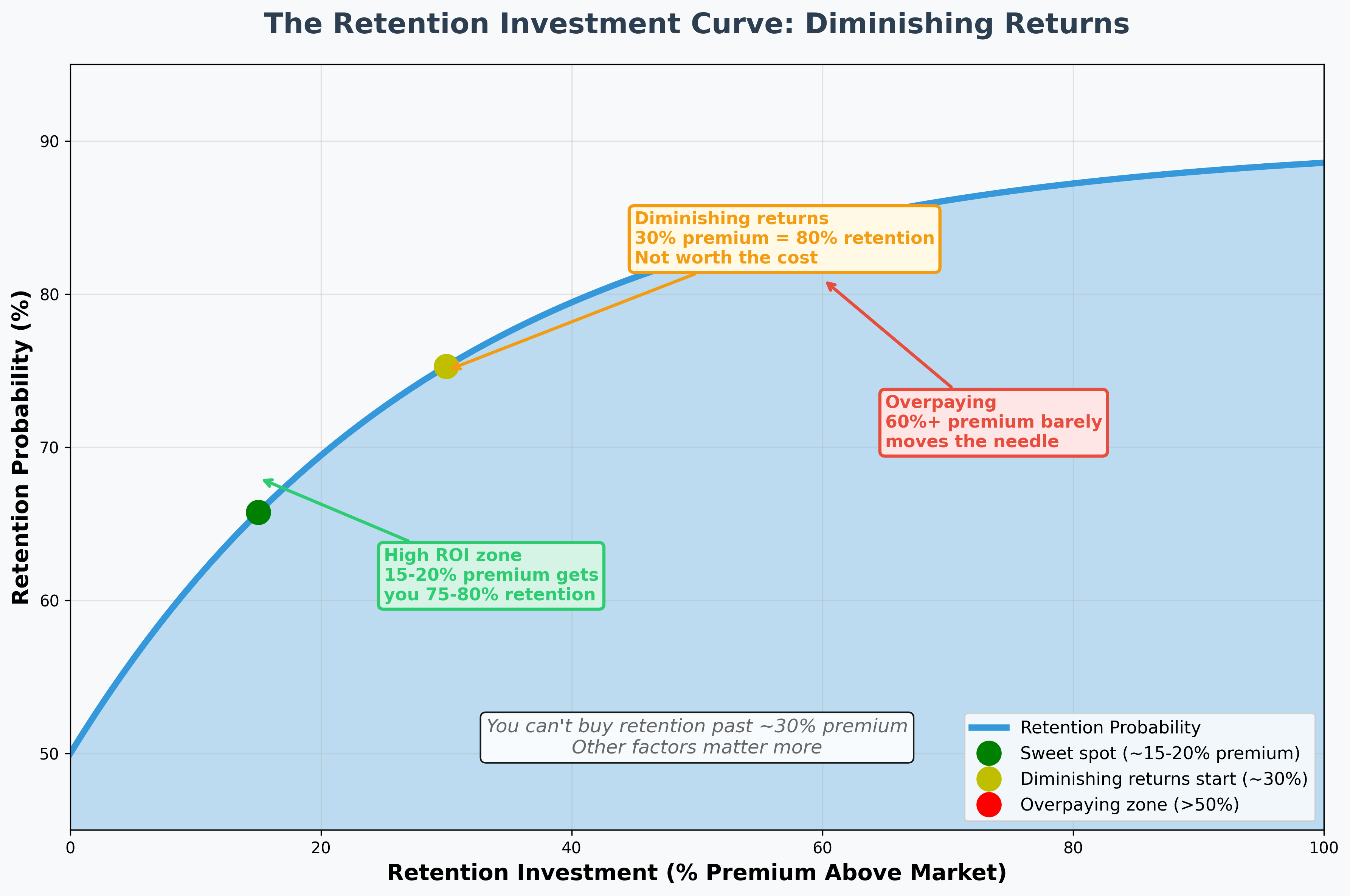
Pattern 2: Specialized Skills in Tight Labor Markets
Even if someone is just a solid performer (not top 20%), if they have genuinely rare skills and the talent market is tight, retention often makes sense.
Examples:
AI/ML engineers (limited supply, massive demand)
Healthcare specialists in rural areas (geographic constraints)
Regulatory compliance experts in niche industries (small talent pool)
Skilled tradespeople during labor shortages (cyclical supply/demand)
Why replacement is expensive:
6-12 month searches (opportunity cost of work not getting done)
Premium salaries (supply/demand means you’ll pay more for replacement than retention)
Geographic constraints (may need to relocate someone, which is expensive)
Training time (specialized skills take longer to ramp)
The retention strategy:
Pay at market or slightly above (market moves fast in tight talent pools)
Focus on non-comp retention levers: remote flexibility, interesting projects, autonomy
Build internal pipeline so you’re not perpetually vulnerable (train/develop others)
Accept that some turnover is inevitable - don’t overpay just because of scarcity
Pattern 3: High Institutional Knowledge Roles
Some people hold knowledge that’s genuinely hard to transfer - not because the knowledge itself is complex, but because it’s tacit, distributed across relationships, or embedded in systems that aren’t well-documented.
Examples:
Key account managers with 10-year client relationships
Long-tenured engineers who understand legacy systems
Operations managers who know all the informal workarounds
Finance people who understand the history behind current structures
When institutional knowledge actually matters:
The knowledge is genuinely hard to document (relationship-based, tacit)
Losing it would create real operational or revenue risk
No one else on the team has meaningful overlap
The time to rebuild the knowledge is >12 months
When institutional knowledge is overrated:
The knowledge is documentable but hasn’t been (that’s a process problem, not a retention issue)
Only one person knows it because of information hoarding (that’s a cultural problem)
The knowledge is about legacy systems that should be deprecated anyway
The retention strategy:
Pay fairly but don’t overpay just because they “know everything”
Simultaneously invest in knowledge transfer and documentation
Cross-train others to reduce single-point-of-failure risk
If they leave, treat it as a forcing function to improve systems and documentation
Pattern 4: Cultural Carriers and Mentors
Some people create value not just through their individual output but through their impact on others. They raise the performance bar, they mentor junior team members, they model the culture you’re trying to build.
Characteristics of cultural carriers:
Other team members actively seek their advice and mentorship
New hires ramp faster when paired with them
They give candid feedback that improves team performance
They attract other strong performers (people want to work with them)
They embody the values you’re trying to reinforce
Why they’re worth retaining even if individual output is only above-average:
They have a multiplier effect on team productivity
Losing them can trigger other exits (people came to work with them)
They’re hard to replace (cultural fit is harder to assess than skills)
The team knowledge they hold is distributed across relationships
The retention strategy:
Recognize and reward their impact beyond individual output (often this means promotion to formal leadership)
Give them opportunities to mentor formally (tech lead, team lead roles)
Involve them in hiring (they’ll help maintain the cultural bar)
Pay them for the value they create across the team, not just their individual contribution
Warning: Don’t confuse cultural carriers with people who are “nice” or “popular” but don’t actually raise performance. The test is: do other people’s outputs improve because of this person’s presence? If yes, they’re a cultural carrier worth retaining. If no, they’re just well-liked.
When to Let People Go (Even Good Performers)
This is the hard part that most managers struggle with: recognizing when letting someone go is actually the right decision, even if they’re contributing value today. These are the patterns where replacement ROI exceeds retention ROI despite the person being above-average.
Scenario 1: Wrong Fit for Future Direction
The company’s direction is changing - new technology, new market, new strategy - and this person’s skills, interests, or working style don’t align with where you’re going.
Examples:
Your best waterfall PM as the company shifts to agile
Your hardware engineer as the company goes cloud-native
Your inside sales specialist as you move upmarket to enterprise
Your individual contributor who’s great at execution but you need builders
Why this is a retention trap:
You’re tempted to keep them because they’re good at what they currently do
But the role is evolving and they’re not evolving with it
You end up either forcing them into a role they’re not suited for (they fail and are miserable) or creating a special role just for them (which is expensive and creates organizational complexity)
The right move:
Have an honest conversation about the direction and the skills needed
Give them 6-12 months to transition skills if they’re motivated to do so
If they’re not motivated or can’t make the shift, help them find a better-fit opportunity
Exit gracefully with severance and, ideally, outplacement support
Why this works:
You free up a seat for someone aligned with the future direction
They find a role where their skills are actually valued
Team sees that you’re serious about the strategic shift
Everyone wins in 12-18 months
Scenario 2: Salary Expectations Exceed Market by 50%+
Sometimes good performers develop salary expectations that are just disconnected from market reality - often because they’ve gotten competing offers at companies that overpay or because they’ve conflated their value at this company with their market value.
The warning signs:
They’re asking for $200K when market for their role is $120K-140K
They think their company-specific knowledge justifies a 50%+ premium
They’ve gotten an inflated offer from a company that’s known for overpaying
They’re anchored on comp from a previous hot job market that’s cooled
Why paying this premium doesn’t work:
Creates massive salary compression issues (how do you justify this to other team members?)
Sets a precedent that threatening to leave gets you off-market comp
They’ll still be unhappy in 12 months when their next “market adjustment” doesn’t come
You could hire two good people for that salary and get more total output
The right move:
Explain the market data transparently
Offer what’s actually market-competitive (maybe 75th percentile)
If they insist on the inflated number, let them take that other offer
Replace them at market rate
Scenario 3: Cultural Drags Despite Good Output
This is the hardest category to act on because the person is technically performing well on paper - hitting their numbers, delivering projects - but they’re creating cultural damage that’s hard to quantify.
What cultural drag looks like:
Creates political drama or camps within the team
Undermines other leaders or initiatives behind the scenes
Takes credit for others’ work, blames others for failures
Spreads negativity or cynicism that’s contagious
Creates an environment where top performers don’t want to stay
Refuses to collaborate, hoards information, sabotages others
Why this is a retention trap:
Their individual output looks good in performance reviews
Exiting them feels unfair because “they’re hitting their numbers”
You tell yourself you can coach them on these behaviors
But the team knows they’re toxic and wonders why you tolerate it
The right move:
Give them direct feedback once about the behavior (not personality)
If it doesn’t change immediately, exit them
Don’t drag it out with PIPs or endless coaching - cultural fit issues rarely improve
Explain to the team (without throwing the person under the bus) that values matter as much as results
What happens after:
Team morale improves almost instantly
Top performers who were considering leaving decide to stay
Collaboration increases, political drama decreases
You wish you’d done it 6 months earlier
The hard truth: One toxic high-performer often drives away 2-3 great team players. The net productivity impact is negative even if their individual output is high.
Scenario 4: Better Opportunity for Them Elsewhere
Sometimes the right retention decision is recognizing that someone has outgrown your organization and the kind thing is to help them leave rather than fight to keep them.
When this applies:
They’ve hit the ceiling in your org and there’s no path up
Their skills have evolved beyond what your company needs
They want experiences (international, different industry, startup) you can’t provide
Their career goals have diverged from where your company is going
Why fighting to keep them often backfires:
You create a special role that doesn’t really fit (”VP of special projects”)
You promote them past their capabilities just to keep them
They stay but are increasingly disengaged and frustrated
They leave in 12-18 months anyway, but now it’s acrimonious
The right move:
Have an honest conversation about their career goals
If you genuinely can’t provide that path, tell them
Help them find the right next opportunity
Exit gracefully, maintain the relationship
They become an evangelist for your company rather than someone who feels held back
The Real Cost of Turnover (By Role Level)
Let’s get specific about what turnover actually costs. Most managers dramatically underestimate the total cost because they only think about recruiting fees and don’t account for all the hidden costs.
The real cost of replacing someone includes five major components:
Recruiting costs - Agency fees (20-30% of salary), job postings, internal recruiter time, candidate travel
Interview time - Manager hours, team member hours across multiple rounds, reference checks, decision meetings
Onboarding - HR admin, training programs, equipment, access setup, initial coaching
Training and ramp time - The period where the new person is producing at 40-70% capacity while consuming 100%+ of normal management time
Productivity gap - Lost output during the search period, work absorbed by remaining team, projects delayed, opportunities missed
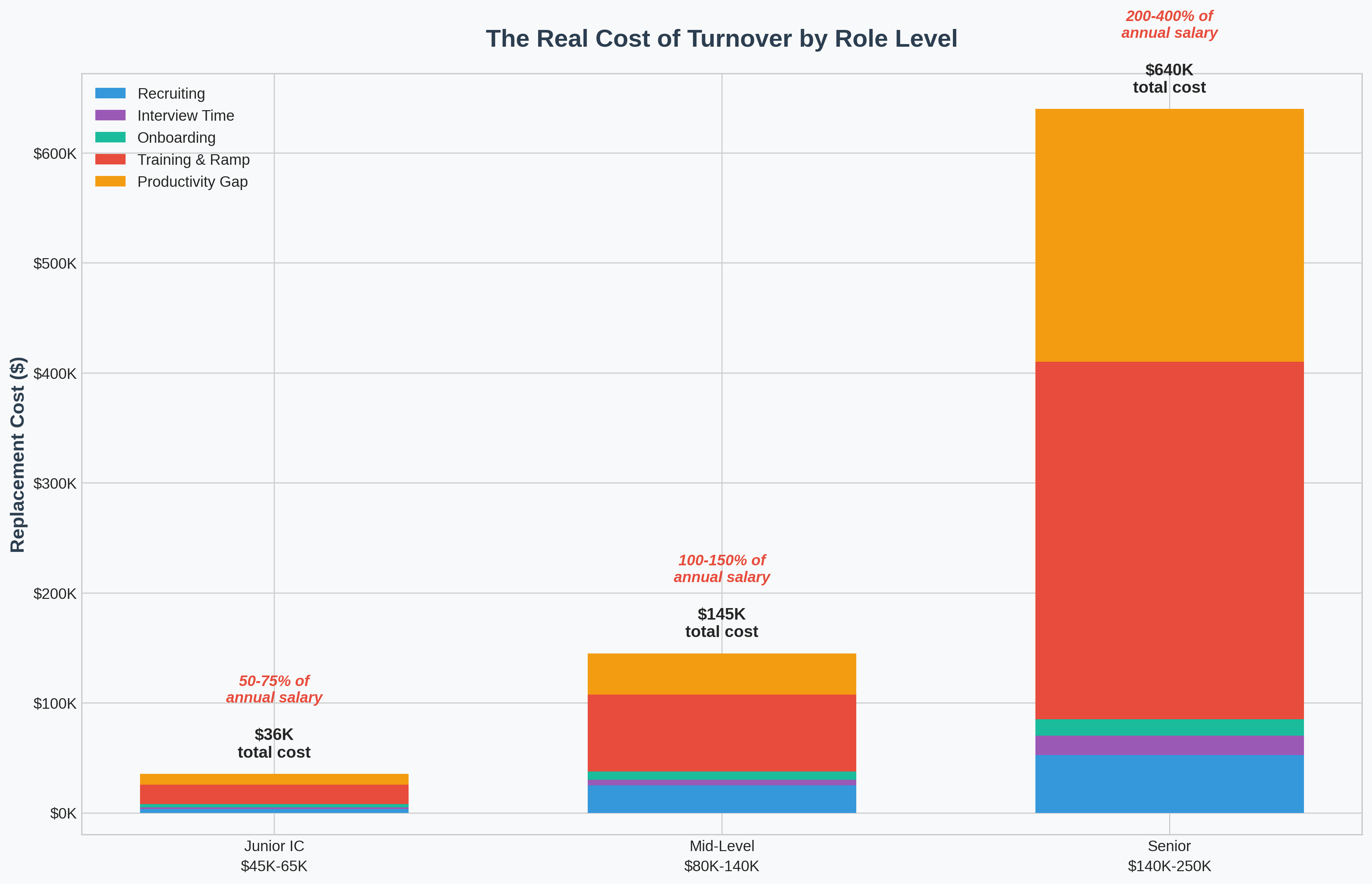
When you add it all up, here’s what replacement actually costs:
Junior roles (individual contributors, <2 years experience): 50-75% of annual salary
Typical range: $22K-49K for a $45K-65K role
Ramp time: 3-6 months to full productivity
Mid-level roles (experienced ICs, first-time managers): 100-150% of annual salary
Typical range: $80K-210K for a $80K-140K role
Ramp time: 6-9 months to full productivity
Senior roles (senior ICs, experienced managers, specialized experts): 200-400% of annual salary
Typical range: $280K-1M for a $140K-250K role
Ramp time: 9-18 months to full productivity
Why senior roles are so expensive to replace:
The costs compound exponentially at senior levels because these people hold institutional knowledge, drive strategic initiatives, maintain critical relationships, and mentor others. When they leave:
Strategic projects stall or fail entirely (opportunity cost in the hundreds of thousands)
Institutional knowledge walks out the door (5-10 years of accumulated wisdom)
Team morale takes a hit (others start questioning the company’s direction)
External stakeholders lose confidence (clients, partners, board members)
You risk a bad hire (30-40% of senior hires don’t work out, forcing you through the cycle again)
This is why a $150K senior person who leaves often costs you $450K-600K in total replacement costs. Fighting hard to retain exceptional senior people almost always makes economic sense - even paying them $200K to stay is cheaper than the replacement scenario.
The Compounding Cost of Serial Turnover
Here’s what makes turnover especially expensive: it compounds. When one person leaves, it increases the likelihood that others will leave too.
The turnover cascade:
Strong performer X leaves
Their work gets distributed to remaining team (everyone now at 110-120% capacity)
Team feels overworked and questions company direction
2-3 more people start interviewing
You’re now hiring for 3-4 roles simultaneously
Quality bar drops because you’re desperate to fill seats
New hires aren’t as good, which frustrates remaining top performers
More exits follow
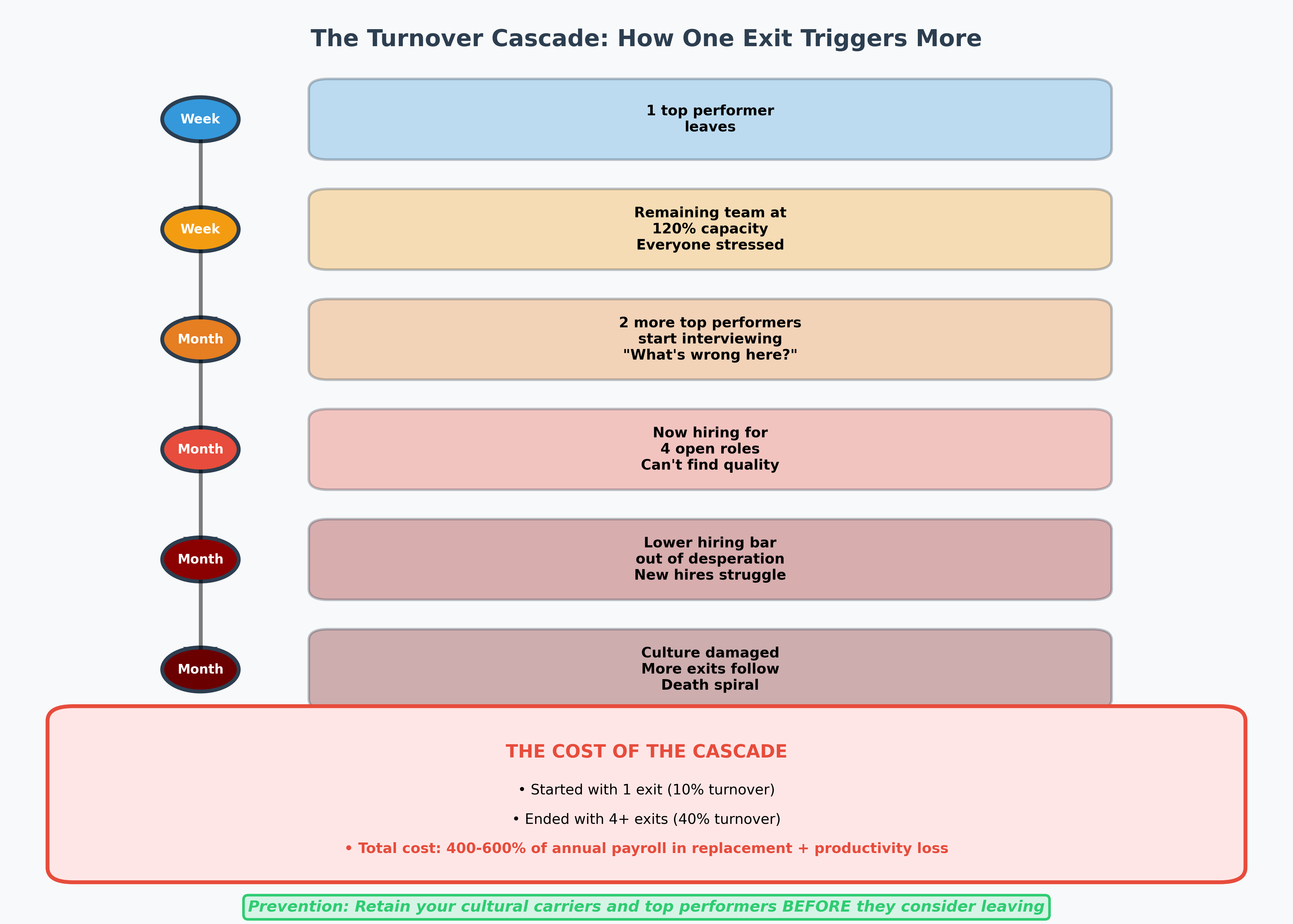
The math: If you have 10% turnover and each exit costs you 150% of salary, that’s a 15% tax on your total payroll. But if that 10% triggers another 10% (cascade effect), now you’re at 30% effective cost. This is why retaining your cultural carriers and top performers is so critical - they’re the ones whose exits trigger cascades.
Common Retention Mistakes (And How to Avoid Them)
Let’s talk about the patterns I see managers repeat that destroy value, burn budget, and still lose people anyway.
Mistake #1: Waiting Until Someone Has an Offer to Invest in Retention
What this looks like:
Someone is a solid performer for 2-3 years at market rate
They get frustrated with lack of progression and start interviewing
They get an offer and tell you they’re leaving
You panic and offer them a 30% raise + promotion to keep them
They accept but are mentally checked out within 6 months
Why this fails:
You’ve signaled that the only way to get ahead is to threaten to leave
Other team members now know the playbook
The person you “retained” is already looking again (they know the first offer won’t be the last)
You’ve created salary compression issues with people who didn’t threaten to leave
You’ve lost their trust - they know you could have paid them fairly before but chose not to
The right approach:
Proactive retention conversations quarterly with top performers
Ask: “What would make you even more excited to be here?”
Invest in development, growth, and compensation before they start looking
Pay them fairly relative to their contribution from the beginning
Don’t wait for market pressure to do the right thing
The economics: Spending an extra $10K/year proactively on a top performer costs you $10K. Waiting until they have an offer and matching costs you $30K + the cultural damage of everyone learning they should interview to get raises.
Mistake #2: Fighting to Keep Everyone (Retention at All Costs)
What this looks like:
Someone announces they’re leaving and you automatically go into panic mode
You don’t ask yourself “should we keep this person?” - you just assume the answer is yes
You match any offer, make any accommodation, create any special arrangement
Your retention budget is exhausted on people who shouldn’t have been retained
Meanwhile your top performers (who aren’t threatening to leave) get nothing
Why this fails:
You’re optimizing for low turnover instead of optimal turnover
You keep mediocre performers at inflated salaries
You create a culture where threatening to leave is the path to advancement
You don’t have budget left for actual top performers
Your team quality slowly degrades as you retain people you should have upgraded
The right approach:
When someone threatens to leave, take 24 hours to think through the retention ROI
Ask: “If they leave and we upgrade this seat, would we be better off in 12 months?”
Fight hard for top 20% performers in hard-to-replace roles
Let go gracefully of everyone else
Use the saved retention budget to invest proactively in your actual best people
The test: If someone tells you they’re leaving, and your honest reaction is relief mixed with guilt, that’s your instinct telling you this is an addition-by-subtraction exit. Listen to it.
Mistake #3: Negotiating with People Who’ve Mentally Checked Out
What this looks like:
Someone gives you notice
You convince them to give you a week to make a counteroffer
You scramble to put together a retention package
They agree to stay
Within 3-6 months they’re checked out and eventually leave anyway
You’ve now lost them twice and paid a premium for the privilege
Why this fails:
By the time someone gives notice, they’ve usually been thinking about leaving for months
The issue is rarely just money - it’s fit, growth, culture, direction
Counteroffers work <20% of the time beyond 12 months
You’ve delayed the inevitable and made it messier
Meanwhile your team knows this person is half-out and morale suffers
The right approach:
When someone gives notice, accept it gracefully 95% of the time
Only counteroffer if: (1) they’re truly top 20%, (2) you can solve the real problem (not just throw money at it), (3) they haven’t fully decided
If you do counteroffer, make it contingent on 2-year commitment with clawback
Otherwise, focus on a smooth transition and maintaining the relationship
The reality: Most counteroffers fail because the decision to leave wasn’t really about money. It was about growth opportunities, culture, direction, or fit. Money can’t fix those things.
Mistake #4: Treating All Turnover as Equally Bad
What this looks like:
You measure retention rate as a single metric (90% retention = good, 80% = bad)
You don’t distinguish between regrettable and non-regrettable turnover
You’re as upset about losing a bottom 20% performer as a top 20% performer
Your retention initiatives try to keep everyone instead of being selective
Why this fails:
Not all turnover is bad - some is addition by subtraction
Treating all turnover as bad means you invest in retaining people you should be upgrading
You don’t focus your retention investments where they matter most
Your team sees you fighting to keep everyone and wonders if you can’t tell the difference between good and bad performers
The right approach:
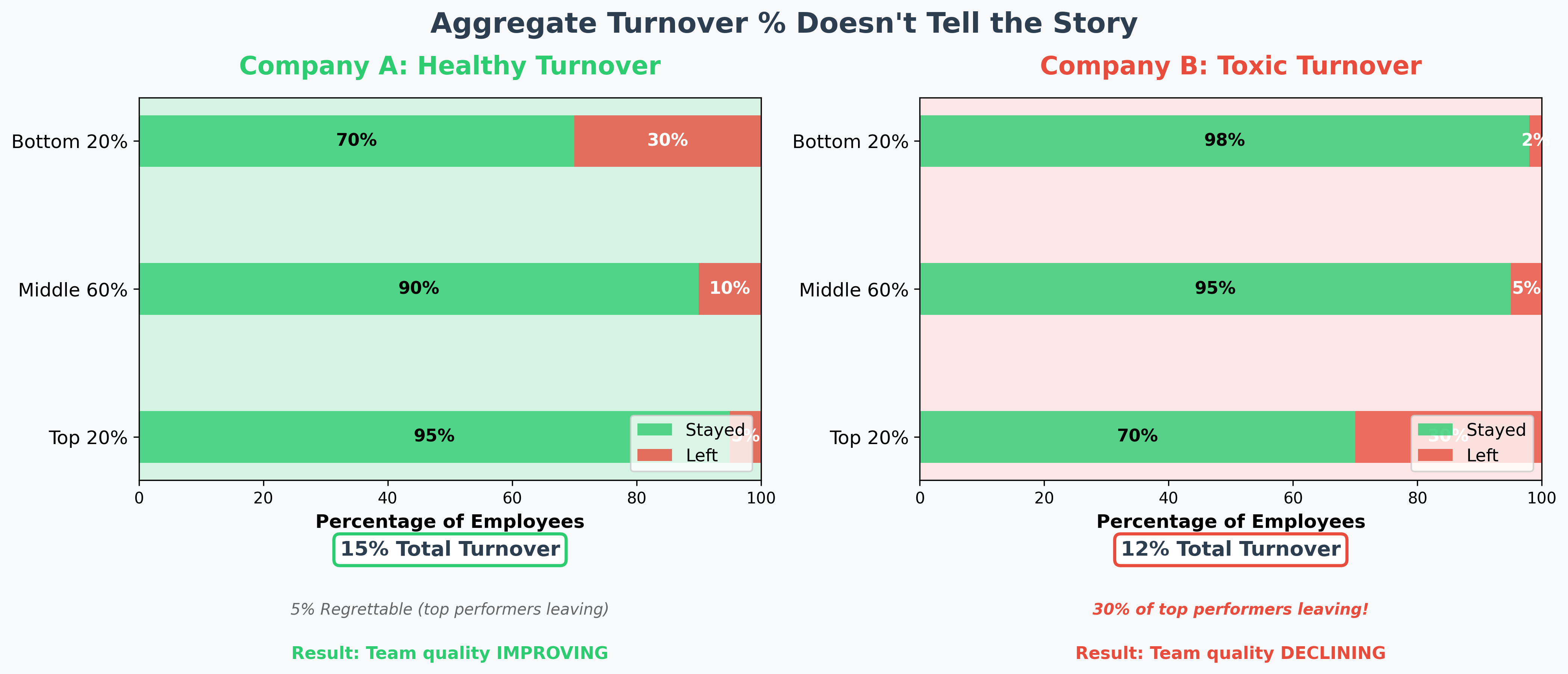
Measure regrettable turnover (top 30% performers leaving) separately from non-regrettable
Target should be <5% regrettable turnover, accept 10-20% non-regrettable
Segment your retention strategies: fight for top performers, facilitate exits for bottom performers
Make peace with the fact that optimal turnover is not zero turnover
The math: 15% turnover where you lose only bottom performers is much better than 5% turnover where you’re losing your best people. The aggregate retention rate doesn’t tell you anything about whether you’re keeping the right people.
Mistake #5: Creating Retention Packages for People Who Aren’t Performing
What this looks like:
Someone in Quadrant 4 (low performance + hard to replace) threatens to leave
You panic because “we’ll never find someone with these skills”
You create a retention bonus, special title, accommodation package
They stay but still don’t perform
You’ve now committed budget to retaining someone who’s not adding value
Why this fails:
Retention packages don’t fix performance issues
You’re using retention budget on someone who shouldn’t have a retention package
The team sees you rewarding poor performance and morale drops
You’ve made it even harder to exit them later (golden handcuffs work both ways)
The right approach:
Don’t confuse “hard to replace” with “worth retaining”
If someone isn’t performing, work on performance first
If they improve, then consider retention investments
If they don’t improve, exit them regardless of replacement difficulty
A gap in the role is better than someone underperforming in the role
The principle:** Retention packages are for people who are performing and you want to keep. Not for people who are underperforming and happen to be hard to replace.
The One Thing to Remember
If you forget everything else from this framework, remember this:
Retention is not about minimizing turnover. It’s about maximizing the return on your retention investments by being strategic about which people you fight to keep, which exits you facilitate gracefully, and which situations require difficult conversations about fit.
The math is clear:
Top 20% performers are almost always worth fighting for (replacement cost is 200-400% of salary)
Bottom 20% performers should be exited respectfully (keeping them costs more than replacing them)
The middle 60% requires judgment based on replacement difficulty and future potential
Optimal turnover is not zero turnover—it’s selective turnover that upgrades your team over time
The operational reality is clear:
Companies that retain everyone end up with teams that slowly regress to mediocrity
Companies that accept all turnover lose their best people and institutional knowledge
Companies that optimize retention strategically compound talent quality over time
This framework should give you the structure to make these decisions systematically instead of reactively going forward.
What a weird and wonderful world,
